Still Going Strong: William Lonsdale’s Athletics Journey
Report by Armen Kanikanian
Bill’s involvement in athletics goes back to his school days growing up in Lancashire, where an active outdoor childhood naturally led him into cross country and track and field. He quickly developed a broad range of abilities, trying everything from sprints to field events, with high jump emerging as his strongest discipline.
By his mid-teens, he had joined Preston Harriers and later competed for Stretford AC (now Trafford AC) while studying at university in Manchester. Known for his willingness to step in wherever needed, he gradually moved towards multi-events competition, eventually focusing on the decathlon. However, a serious ankle injury sustained in the pole vault at 28 brought that phase of his athletics to an end.
Athletics then took a back seat as family life and career became the priority. It wasn’t until he turned 50, while living in Aberdeen, that he returned to the sport, initially through marathon training after securing a charity place for the London Marathon. Starting again from scratch, he rebuilt his fitness and soon rediscovered his ability in the field. Shortly after returning to club athletics, he surprised himself by winning a senior club high jump competition, which reignited his competitive drive.
From there, Bill became increasingly involved in masters athletics, combining endurance training with multi-events competition and representing at international level. One of his standout achievements came in 2017, when he won bronze in the M65 pentathlon at the World Indoor Championships in Daegu (South Korea).
A lesser-known highlight dates back to 2012, during an academic exchange programme in Sydney, Australia. During a strong period of training, he set an M60 course record over 14km with a time of 1:01:13 – a mark that still stands.
Later in 2017, Bill experienced a significant health setback, suffering a heart attack caused by previously undiagnosed familial hypercholesterolaemia. Following angioplasty and the fitting of a stent, he completed cardiac rehabilitation and gradually returned to training. He credits his long-term fitness with helping him recover, having developed collateral circulation that allowed blood to bypass a major blockage.
Since then, he has continued to train and compete consistently, particularly over the marathon distance. His personal best stands at 3:12:44, achieved at the Loch Ness Marathon at age 60, while more recently he ran 3:50 at Dorney Lake at 70, comfortably inside the Good for Age standard for the London Marathon. After a brief setback due to knee surgery, he returned to form in 2025, securing another qualifying time.
Bill joined ESM in 2015 after relocating to be closer to family. He remains an active member of the club while also maintaining links with Aberdeen AC and Scottish Masters, for whom he has competed internationally.
Motivation, he says, has always come from a combination of competition and personal standards: “the help and camaraderie of team mates is an important element, although I do still like to beat them.”
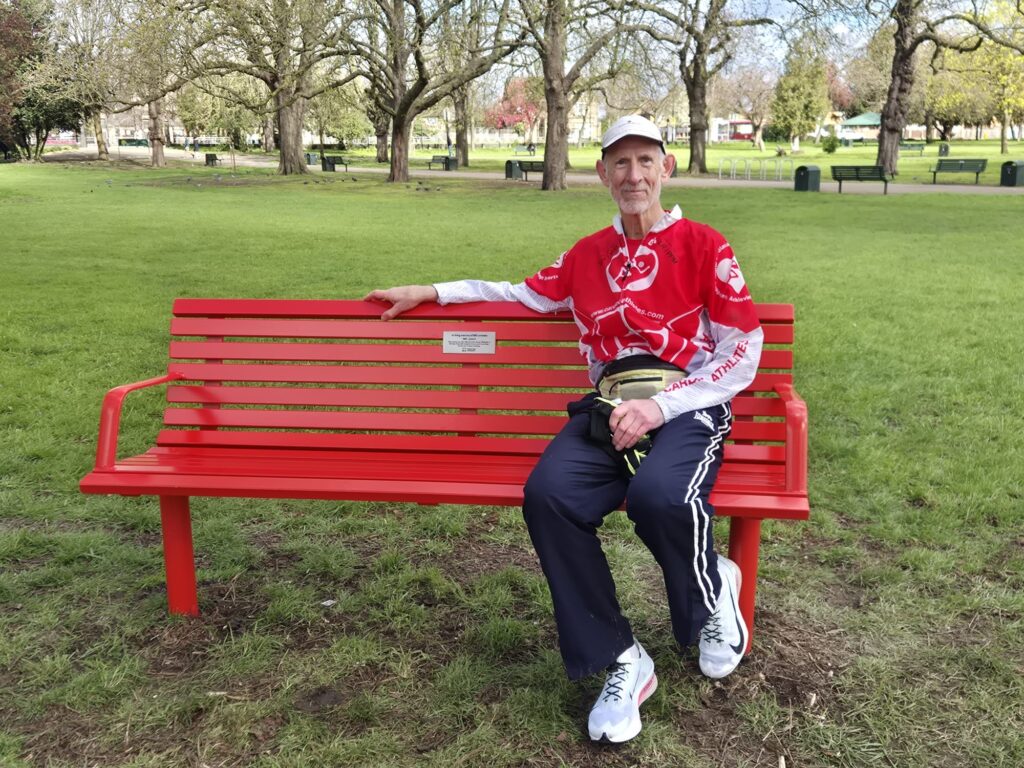
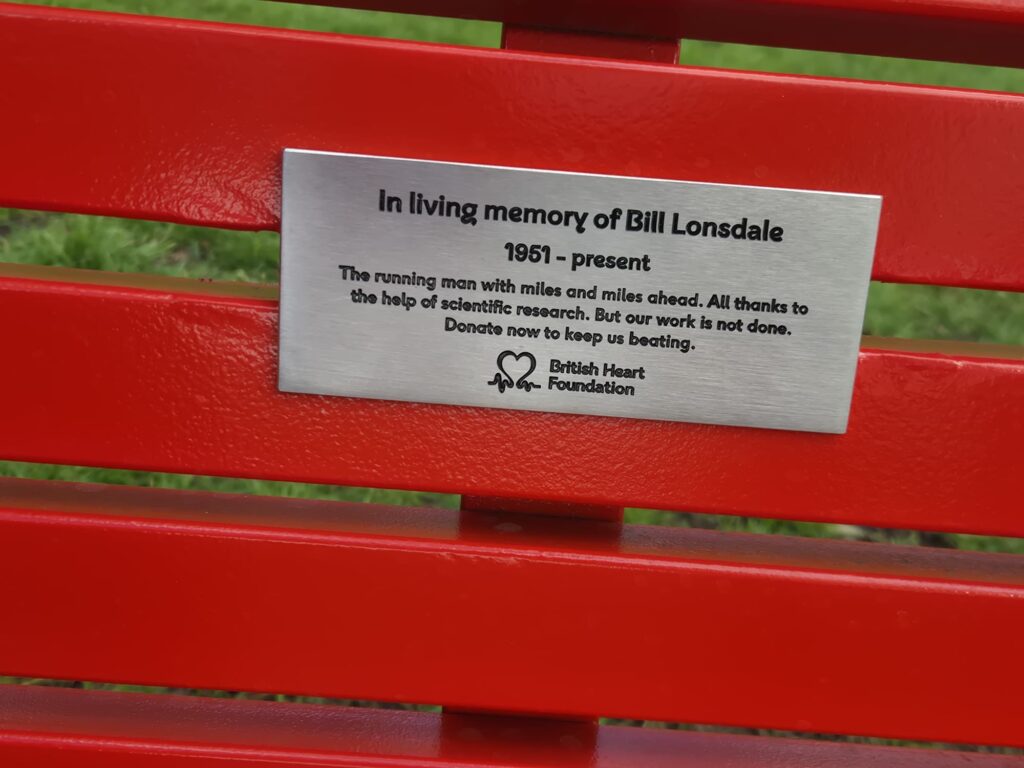
Away from competition, Bill also has a visible connection to the British Heart Foundation through the installation of a red bench at Southall Park, near the start of the local parkrun. The bench forms part of a national campaign recognising people who have survived serious cardiac events and gone on to lead active lives. For Bill, it serves as both a personal marker and a quiet reminder of the importance of maintaining a healthy lifestyle.
Bill will be running in the London Marathon on 26th April, raising funds for BHF, with a funding profile at https://2026tcslondonmarathon.enthuse.com/pf/william-lonsdale